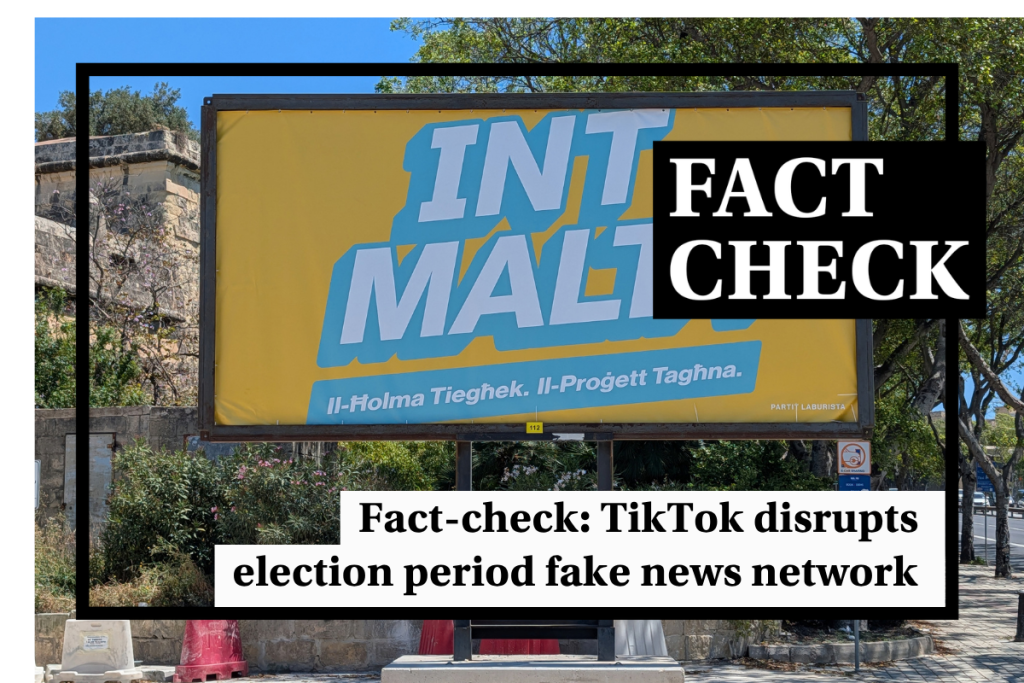
TikTok shut down a network of fake “news” accounts used to artificially boost pro-Labour Party narratives during the general election campaign, the platform has revealed.
The social media company said it identified and removed nine accounts operating as part of a network targeting Maltese users.
This was primarily done through fake profiles that the network “presented as news accounts”.
In total, the nine accounts had 433 followers at the time they were shut down.
TikTok has not disclosed who was behind these accounts, nor whether these individuals hold any link to any political party, organisation or holder of political office.
Malta’s network was one of seven flagged by TikTok worldwide in May. The platform also detected similar networks in Serbia, Russia, Colombia, Armenia and Peru, as well as a China-based network targeting US foreign policy.
The Labour Party said the accounts were not among its official social media channels, which are managed by party officials.
It added that anyone could create an account to spread information, and said the network’s reach was negligible compared with engagement on its official pages.
‘Disproportionate societal harm’
TikTok describes covert influence operations as “coordinated, inauthentic behaviour where networks of accounts work together to mislead people or our systems and influence public discussion on important social issues, including elections”.
The platform has warned that while these types of networks are relatively rare, they “seek to cause disproportionate societal harm and use particularly sophisticated tactics”.
TikTok’s report suggests that Malta is no stranger to the online electoral disinformation which has come to play a key role in elections around the world. TikTok, in particular, is “reshaping electoral communication,” with little understanding of its effects, disinformation experts warn.
Early in last May’s election campaign, Times of Malta reported on a series of troll TikTok accounts using AI-generated images and videos to undermine electoral pledges and ridicule political figures.
Many of these accounts appeared to echo one another, adopting similar attack lines against political opponents and repeating similar talking points.
Many of these accounts have either stopped posting since election day, or else shut down altogether.
A July report by the Mediterranean Digital Media Observatory also flagged similar activity.
The report identified a series of web domains registered between March and May, in the weeks leading up to the election, seemingly serving a similar purpose.
These sites ranged from browser-based games mocking the opposition leader, to others posing as news or fact-checking sites, mostly promoting pro-Labour narratives and electoral pledges.