

Claims frequently made by Malta’s construction lobby that Malta’s planning appeals process facilitates frivolous appeals by members of the public are not reflected in newly-available data about construction appeals.
The claims come as Malta’s parliamentarians discuss a new bill to regulate Malta’s appeals process.
Developers have frequently argued that frivolous appeals filed by neighbours and members of the public often delay projects and add to the planning system’s backlog.
However, figures from property aggregator Pedament show that Under two per cent of planning permits issued last year faced appeals submitted by the public, far fewer than the number of appeals filed by developers,
The figures reveal that the bulk of planning appeals are filed by developers unhappy at their permit being refused, rather than members of the public hoping to block a permit which had been granted.
In total, the 138 appeals filed by members of the public in 2025 make up under two per cent of the 7,200 permits granted by the Planning Authority throughout the year.
Meanwhile, developers or applicants lodge an appeal in almost half of cases in which their applications are rejected.
The analysis comes as the government mulls new rules which would pause permits once an appeal is filed and set tighter deadlines for deciding appeals.
Both developers and environmental NGOs have said they favour the move in principle.
Pedament’s analysis reviewed 9,343 planning appeals on the Environmental and Planning Review Tribunal’s (EPRT) register, dating back to the year 2000, successfully matching almost all of them to their respective planning permit.
Who typically files an appeal?
About 400 appeals are filed throughout most years, although there are occasional exceptions.
In 2011, 788 appeals were lodged, with the number dipping drastically to under 200 in 2014 and 2015.
The most recent full year, 2025, falls squarely in the middle, with 413 appeals opened.
Most appeals are filed by developers who are unhappy at their permit being refused.
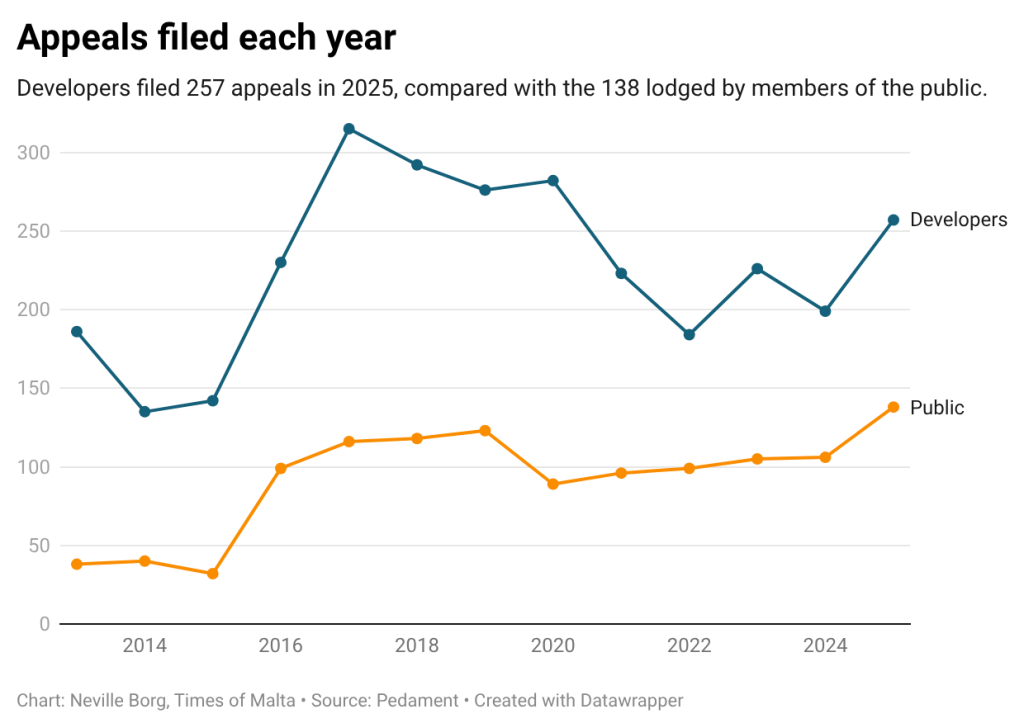
Of the 413 appeals opened in 2025, 257 were filed by developers objecting to a refusal, with 138 opened by members of the public.
This pattern has persisted over time, with developer appeals far outnumbering those from the public each year since 2013, although both have increased over the years.
Nevertheless, the figures suggest, developers have become more reluctant to appeal once their application has been turned down.
In 2014, most permit refusals (58%) were appealed. By 2025, this had gone down to 43%.
By contrast, the public appears to have become slightly more emboldened to file an appeal once a permit is granted, although the numbers remain low.
Under 2% of the more than 7,200 permits granted in 2025 were appealed. In 2014, this rate even lower, at just 0.6%.
However, while members of the public lodge far fewer appeals, their appeals are four times more likely to reach the court of appeal, compared to those originally filed by developers.
In total, 14% of appeals filed between 2021 and 2025 were eventually taken to court, the analysis shows. This includes 31% of the appeals originally filed by the public, compared to under 8% for those filed by developers.
Fine, but who usually wins the appeal?
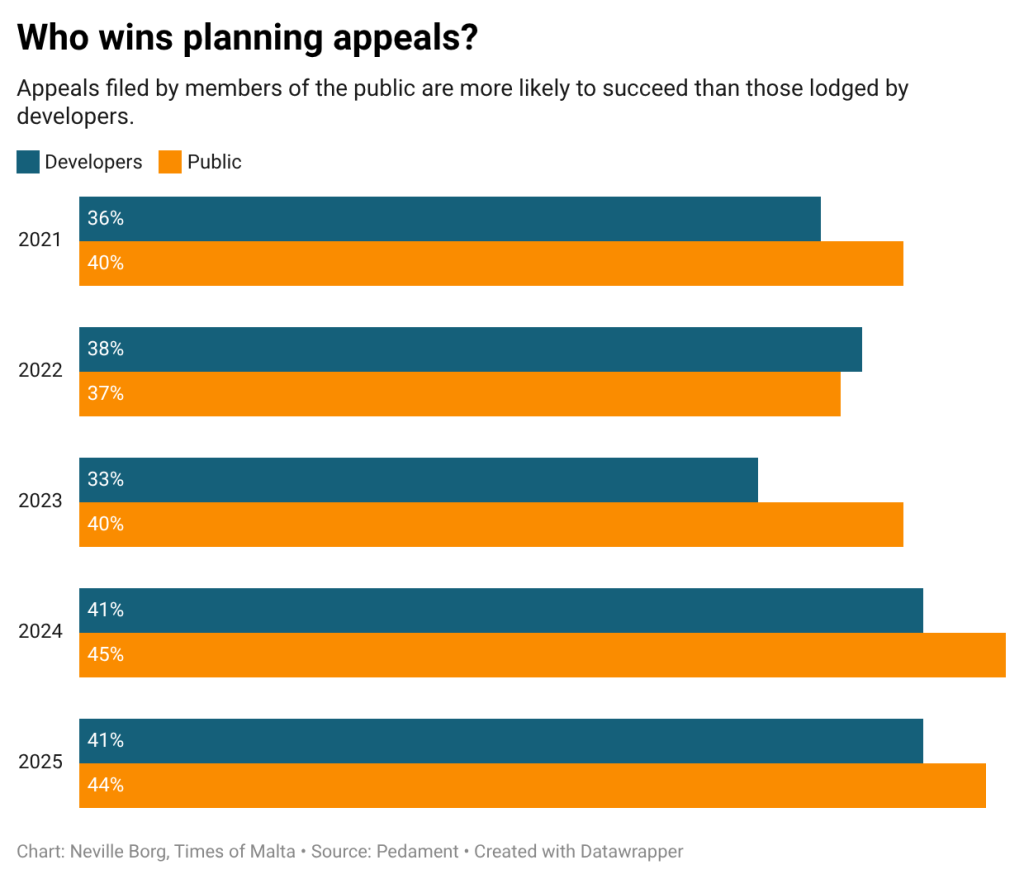
It’s a coin toss, the data suggests, although the public has a slight edge over developers.
In 2025, 44% of all the appeals filed by members of the public were either fully or partly successful.
In total, the public won 56 appeals decided in 2025 and lost a further 56 cases. Another 16 appeals were either withdrawn, deemed inadmissible or settled in another manner.
Developers, meanwhile, won 41% of their appeals last year, with the tribunal either fully or partly upholding their appeal in 99 cases. However, the tribunal dismissed almost one in every two cases filed by developers, with 124 appeals thrown out.
However, applications in ODZ areas which are initially turned down stand a fighting chance of being overturned on appeal, the figures show.
Between 2020 and 2025, there were 711 rulings over permits on ODZ sites being refused. Over a third of them, 35%, were overturned.
How long do appeals take to be decided?
Much less than they previously did, the analysis shows.
Under the proposed new rules, the tribunal would have six months to determine the case, while the Court of Appeal would have a further four months, with an option of a two-month extension.
While the appeals system remains some way off these targets, it has been narrowing the gap, Pedament’s analysis suggests.
The figures show that the tribunal schedules an appeal’s first hearing within three months of the permit being issued, kicking off the 30-day window in which an appeal may be lodged.
This three-month timeframe has remained stable over the years, the analysis suggests.
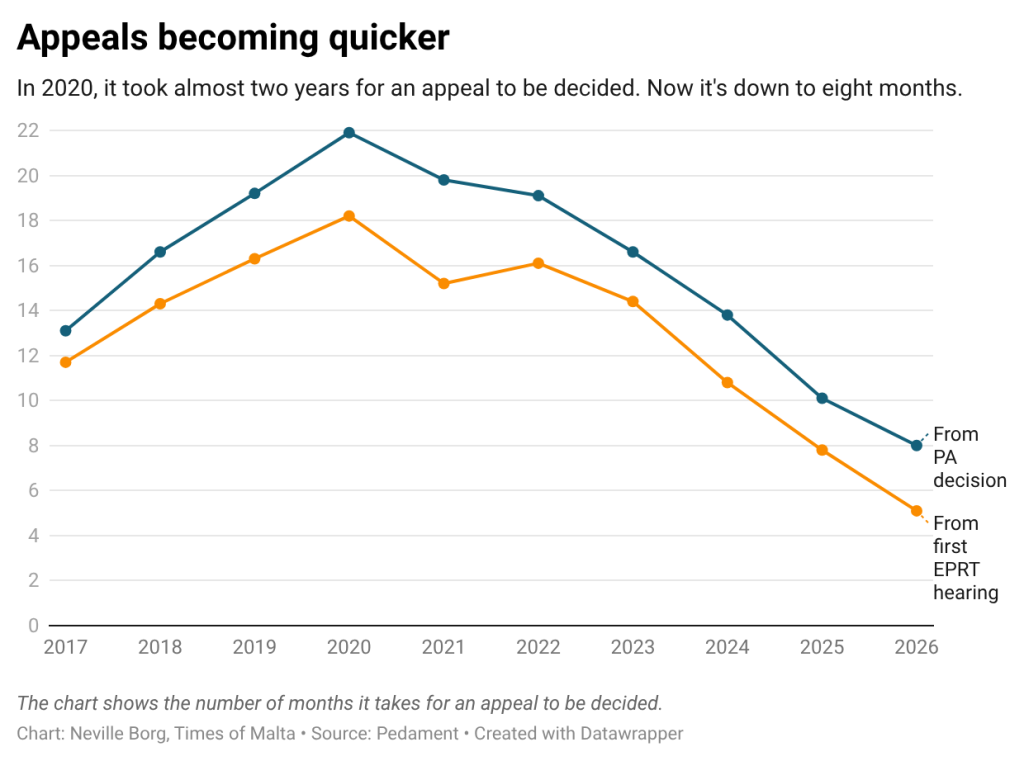
Appeals then took a further 18 months to be decided at their 2020 peak. This has now been slashed to eight months in 2025.
In total, most appeals in 2025 were decided within 10 months of the permit being issued, compared to just under two years – 22 months – in 2020.
This appears to be on track to fall further, with the median waiting time for the first half of this year down to eight months in total.
These figures also show that a growing number of appeals are decided within the same year in which they were first heard.
Almost three-quarters (72%) of appeals first heard within the second half of last year were decided over the following six months, the analysis shows. Back in 2019, this figure was at a lowly 8%.