Speaking to party faithful on Sunday March 1, Prime Minister Robert Abela said that while previous budgets had removed tax on the maximum pension equivalent, commonly known as the two-thirds pension, pensioners who continued to work or had other investments were still finding themselves paying tax.
“Now, for all pensioners who have an income double the maximum pension, all that income will be tax-free,” Abela said, citing an upcoming legal notice which would mean that “from next week, they will pay 0% tax”.
This measure was first hinted at during last October’s budget speech, during which Finance Minister Clyde Caruana said “starting next year, pensioners with income exceeding this amount, including those who are employed, will have twice the maximum pension equivalent exempt from taxable income, meaning it will not be included in tax calculations”.
The process to exempt this additional income from tax began in 2022 and would be completed in 2026, Caruana said.
What does this refer to?
In practice, the state’s two-thirds pension is currently not taxed, under rules introduced across several budgets over the years.
The maximum state pension a person receives varies according to different factors, including when they were born and their contributions over the years, but this typically hovers around the €18,000 mark in 2026.
However, anyone with an income above this figure, whether it’s from a private pension or from other sources, would pay tax on the additional income in line with Malta’s income tax bands, typically at a rate of 25%.
Two separate, but related, measures promised to change this.
The first, which kicked off in 2022, introduced a progressive five-year plan for additional income above this figure to also be exempt from tax, with the non-taxable portion increasing by 20% each year.
At the same time, pension income was separated from other income sources, for tax purposes, meaning any income a pensioner receives aside from their pension (for instance, from renting out a property or by working part-time) is taxed on its own steam, rather than as a cumulative total.
In a statement published on Tuesday, the finance ministry said “since pensions are now practically all exempt from tax, other income is now being taxed at a normal rate and no longer added to the pension”.
I’m confused, what does it mean?
Let’s take the example of a pensioner who earns the maximum two-thirds state pension (roughly €18,000) and earns an additional income by renting out an apartment at €1,000 each month, for a total annual income of €30,000.
In practice, this pensioner will not pay tax on their state pension, just like any other pensioner. Meanwhile, the rental income will be taxed in line with Malta’s tax bands starting from €0 rather than starting the count at €18,000.
So, just like any non-pensioner, they will not pay tax on their first €12,000 income if they are on a single computation, or €15,000 if they are on a married rate.
This means that a pensioner on a married rate can potentially earn up to €33,000 (an €18,000 state pension plus a further €15,000 from other sources) tax-free, while those on a single rate will have their tax-exempt income capped at €30,000.

What’s the second measure?
However, Abela was referring to a second measure, introduced this year, through which the threshold of tax-free pension income has risen to just over €37,000, rather than the previous €16,600.
This measure came into effect through a new legal notice published earlier this month.
However, the legal notice reveals that, contrary to what Abela suggested, this measure only applies strictly to income derived from pensions, not to income from other investments, rentals or employment.
The legal notice raised eyebrows, with many taking to social media to express their surprise. Meanwhile, in a press conference on Tuesday, PN accused Abela of “deceit”, saying the widespread tax exemptions he promised did not come to pass, with only a small fraction of pensioners benefiting from the change.
How many people even earn a pension of €37,000?
Probably relatively few, although public information about this is scarce.
In a statement, the government said some 16,000 pensioners will benefit from the new measure, meaning they earn between the old taxable threshold of €16,600 and the new cap of €37,000, although the precise figure is not known.
Nevertheless, it appears likely that many of these 16,000 are towards the lower end of this scale.
Late last year, in a reply to a parliamentary question by opposition MP Graham Bencini, Social Policy Minister Michael Falzon said there were some 87,000 people receiving some form of pension. Of these, 67,000 were receiving a retirement pension, with others on a widow’s or disability pension.
This suggests the measure could impact roughly a fifth of all of Malta’s pensioners.
However, statistics suggest that low income among pensioners remains a persistent problem.
The same series of parliamentary questions filed by Bencini shows that, as of last year, there were 735 pensioners who had a total income of less than €600 every four weeks, with a further 1,600 pensioners receiving between €700 and €800.
EU data also suggests that Malta remains among the continent’s lowest spenders on pensions, with only Ireland spending less of its GDP on pensions. In total, the data shows, Malta’s expenditure on old-age pensions was €10,600 per beneficiary in 2022, comfortably lower than the EU-wide average of over €16,000.
Verdict
A new legal notice introduced earlier this month raising the threshold for pensioners’ tax-exempt income to €37,000 only applies to income derived from their pension.
Any income they receive from other sources, including rentals, investments and employment could still be subject to tax.
However, other measures mean that, in effect, as much as €15,000 of pensioners’ additional, non-pension, income could also be tax-free. This means that a pensioner on a married rate could earn roughly a combined €33,000 through their pension and other sources without paying any tax.
The claim is therefore misleading as, although the claim may, in itself, be partly or entirely true, it is presented in a manner that is not representative of the facts within a broader context.
The Times of Malta fact-checking service forms part of the Mediterranean Digital Media Observatory (MedDMO) and the European Digital Media Observatory (EDMO), an independent observatory with hubs across all 27 EU member states that is funded by the EU’s Digital Europe programme. Fact-checks are based on our code of principles.
Let us know what you would like us to fact-check, understand our ratings system or see our answers to Frequently Asked Questions about the service.

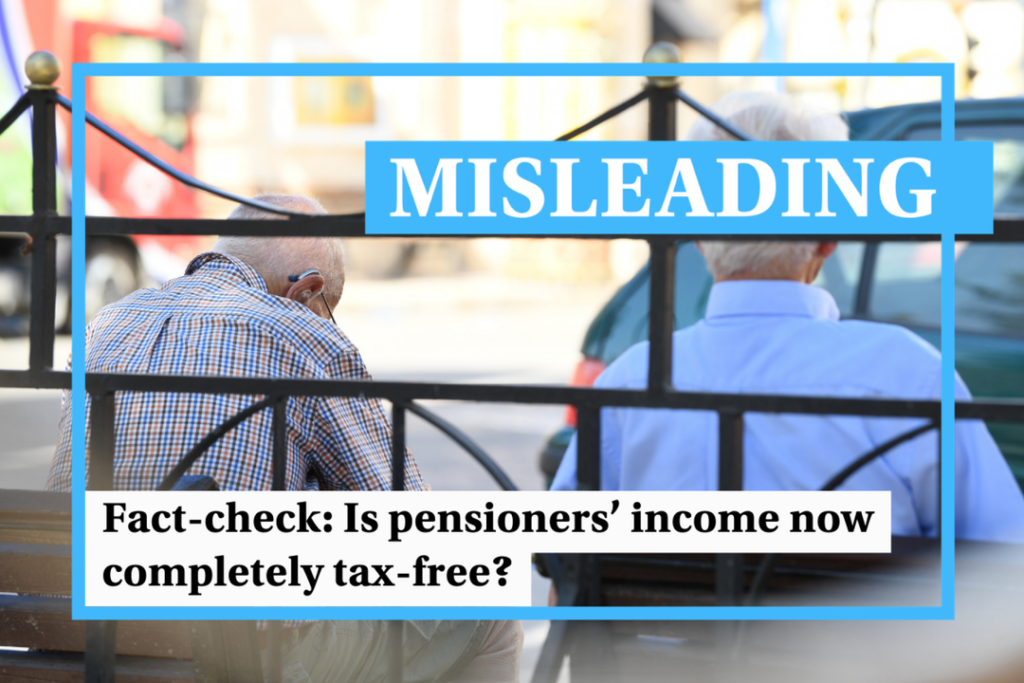
A dispute over a new budget measure came to light in recent days. File photo: Matthew Mirabelli
Copyright 2026 Times of Malta. All rights reserved.
Originally published here.